
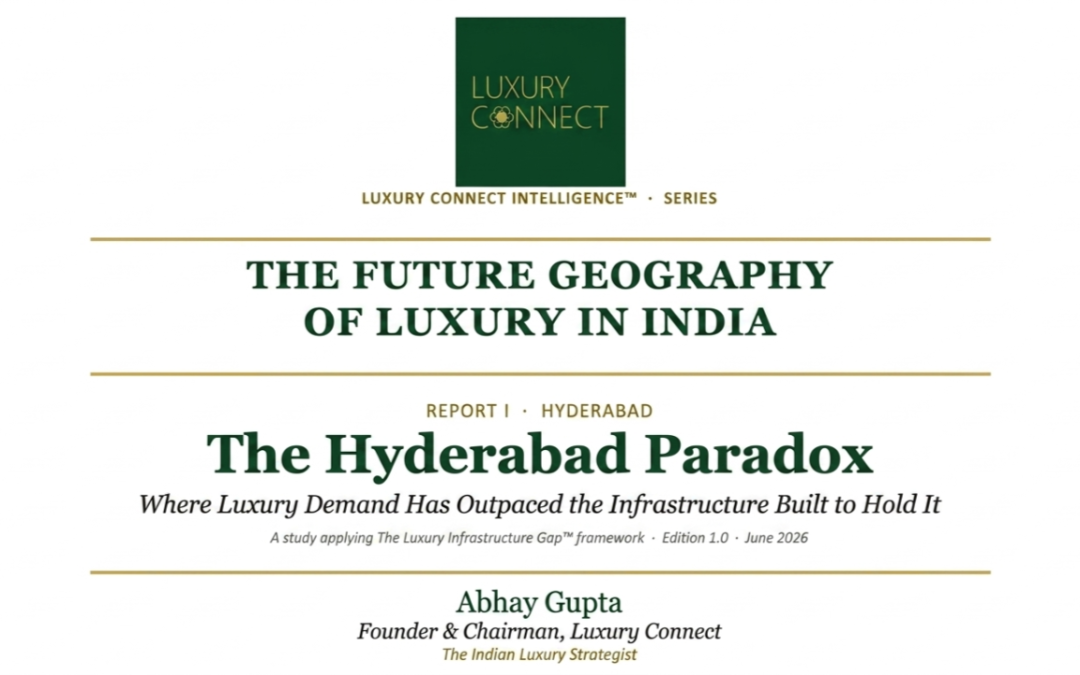
The question every global luxury house asks about India is the same: which city, after Mumbai and Delhi? The industry defaults to Bengaluru. The data points to Hyderabad.
Not because Hyderabad is more visible. Because the gap between what its luxury market demands and what has been built to serve it is the sharpest, most measurable reading available in India right now.
That gap is why LC Intelligence — Luxury Connect’s new research vertical — launches its inaugural series with Hyderabad as Report I.
Why Hyderabad First
The choice of Hyderabad is deliberate and diagnostic. It is the largest ultra-luxury residential market in South India by value. Ultra-luxury housing stock at ₹8,562 Cr signals a consumer base that is not aspirational — it is transactional. These are households that are already buying at the highest tier.
And yet: zero pure-play luxury malls. No equivalent luxury retail infrastructure. A city that has built the demand but not the architecture to serve it.
This is not a coincidence. It is the result of a specific coordination failure — one that the report maps in detail across eleven exhibits and eight chapters.
The Readiness Matrix
The methodology at the centre of the LC Intelligence series is the Luxury Readiness Matrix — ten indicators assessed across two dimensions: demand and infrastructure. Each scored on a five-point ladder from pre-awareness to full lifestyle integration.
Hyderabad’s demand score: 4.0. Hyderabad’s infrastructure score: 2.2. The Gap: 1.8.
That asymmetry — a consumer base ready for Level 4 engagement met by infrastructure still at Level 2 — is the Hyderabad Paradox. And it is not unique to Hyderabad. It is India’s pattern, concentrated and visible in one city.

The Leakage Economy
The consequence of this gap is measurable at the national level. India’s overseas luxury travel spend reached US$17 billion in FY2025. A significant portion flows to Dubai, Singapore, Paris, and Bangkok — not because those cities have stronger luxury mythology than India, but because they have built the infrastructure to make luxury spend feel purposeful: VAT refund systems, concentrated luxury districts, hotel-to-boutique proximity.
Not all of that spend is recoverable. But recapturable leakage is real. Build the equivalent and a portion comes home.
The Window
The opportunity is not permanent. Luxury clusters form through a specific sequence: Anchor → Adjacency → Density → Gravity. Hyderabad has three candidate nuclei — the approved Ritz-Carlton development, the Kokapet corridor, Neopolis — but no anchor has triggered the formation sequence.
The house that moves first does not chase gravity. It creates it.
That is the window this report is written to map. Bengaluru follows as Report II. Then Chennai and Pune — the same framework, the same indicators, every market fully comparable.
The Future Geography of Luxury in India is not a one-city analysis. It is the beginning of a rigorous, city-by-city map that India’s luxury decision-makers currently do not have.
Report I — The Hyderabad Paradox — is available now at https://luxuryconnect.in/lc-intelligence/
Two institutions behind this thinking: Luxury Connect Business School — India’s only MBA in Luxury Brand Management. August 2026 applications open. lcbs.edu.in
Luxury Connect — Strategy, market entry, brand architecture. luxuryconnect.in
View / Buy : The Future Geography of Luxury in India — Report I: The Hyderabad Paradox | Executive Summary via ‘View Snapshot‘
Recent Comments